
Where the
Tanks Stopped
From clear water to overgrown armour, a closer look at the machines that remain within a living island.
From above, the water offers little resistance to the eye.
You can look through it, follow the changes in colour, trace the pale bottom beneath the surface. Then something interrupts the view. Straight edges. A turret. A shape built for an entirely different setting.
A tank in the lagoon.
The film is brief. Long enough for the eye to recognise the machine and begin looking around it. Water moves across the view. The tank holds its place.
There was a journey intended for that machine. A crew would have worked within its confined spaces, looking out through openings far smaller than the view we have now.
The aerial image gives us an outline. It leaves the circumstances of this particular tank’s arrival to be established.
The shore was only part of the battlefield
American forces landed on Saipan on 15 June 1944. Men and equipment crossed from ships toward the island under fire. The fighting would extend inland, but the passage through the water was itself part of the battle.
Today, US Sherman tanks are among the remains documented by the Battle of Saipan maritime heritage trail. Together with other submerged vehicles and wrecks, they extend the historical landscape beyond the beach.
That wider context matters. A tank in the water can become an isolated curiosity when seen without the shore it was approaching, the equipment around it, or the people involved.
The footage draws us toward one machine. The history asks us to widen the view.
Among the leaves
On land, the photographs bring us close enough to lose the outline.
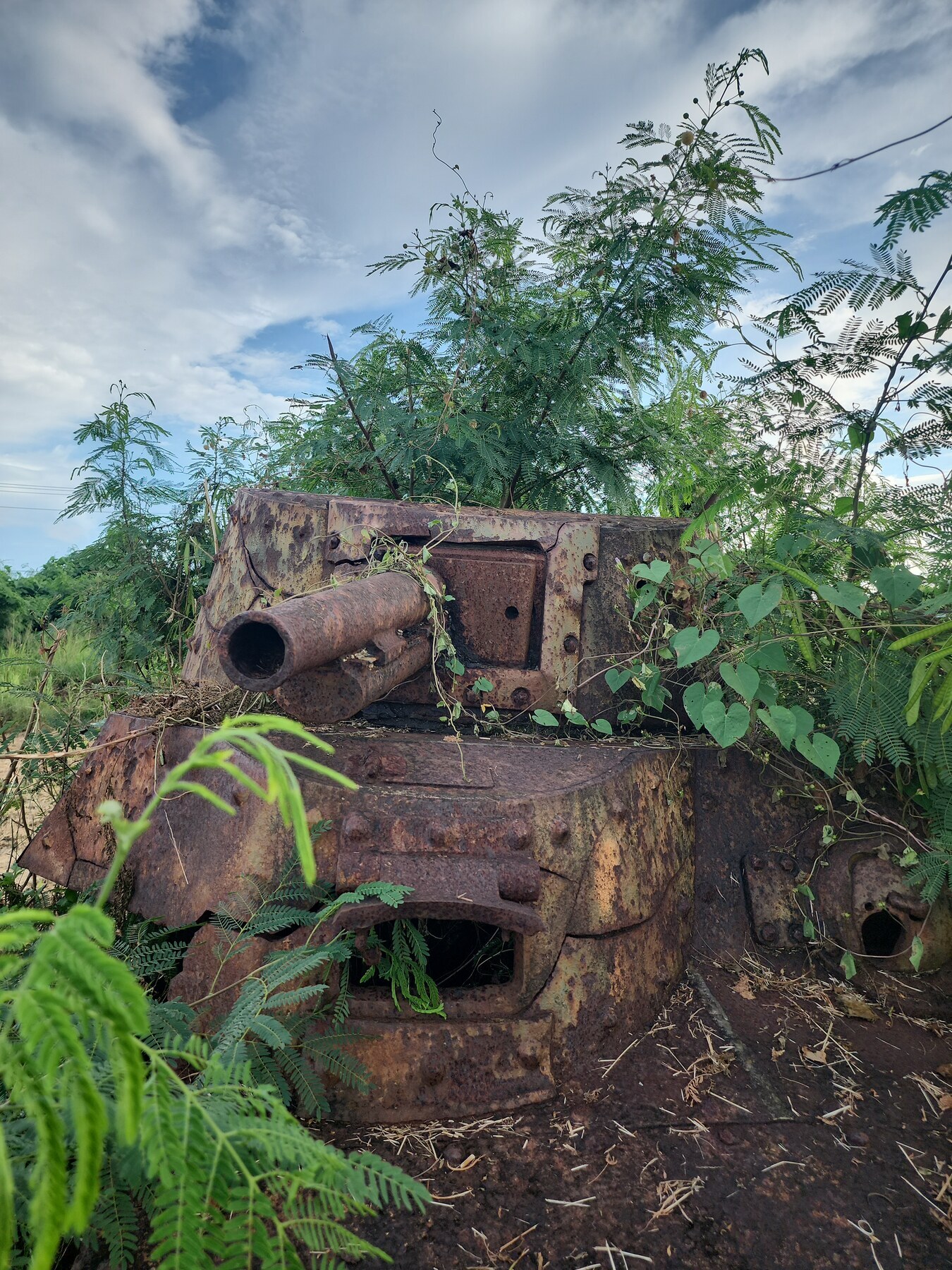
A short barrel projects beneath branches. Rust gathers around openings. Stems and fern fronds cross the armour, dividing the machine into small areas of metal and shadow.
It takes a moment to separate one from the other.
From a distance, corrosion can reduce a vehicle to a single colour. Here, the surface is uneven: dark edges, lighter patches, fastenings and holes that become visible as the eye slows down.
The second photograph changes the scale again. An opening occupies much of the frame. Plates of corroded metal surround a dark interior, while fine leaves hang across the upper edge.
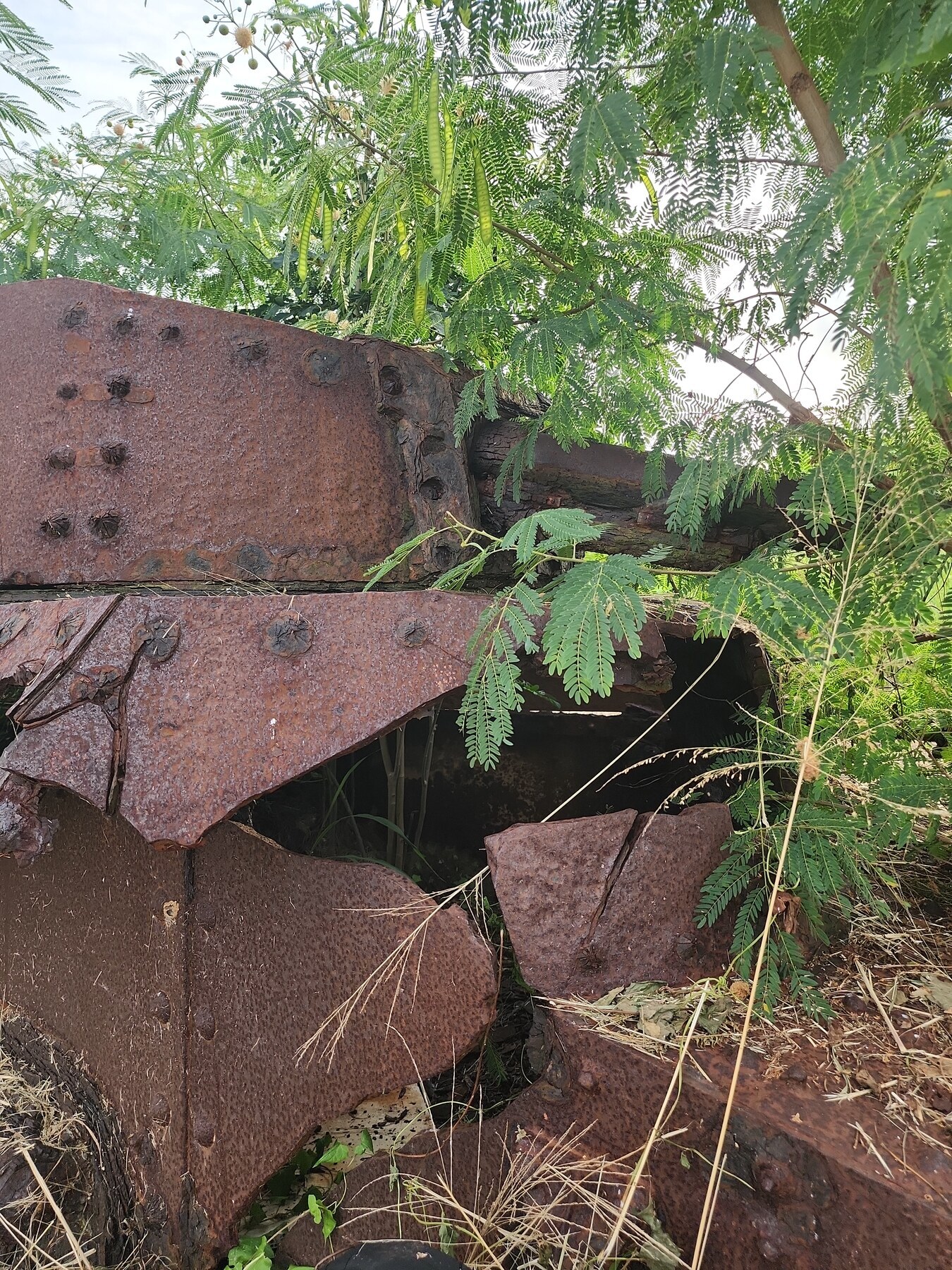
What survives beneath the growth? Which parts are absent? Has the vehicle remained in this position, or was it moved after the war?
The photographs do not settle those questions. They preserve details that may help answer them.
Two settings, different questions
The sea photograph and the land photographs invite comparison, but they do not establish a shared unit, engagement or sequence of events.
Each vehicle needs its own account.
In the lagoon, visibility depends on the surface and the light. On land, vegetation conceals features that may be important to identification. A shape that looks clear in one photograph can become difficult to interpret from another angle.
Historical records may place a type of vehicle in an area. A closer examination may reveal construction details or surviving markings. Connecting those findings to an individual machine takes further work.
Recognition is a beginning. There is still a considerable distance between “a tank on Saipan” and a supported account of how this tank came to rest.
The island around the armour
The machines draw the eye. They should not hold the whole story.
Saipan was home before it became a battlefield. The war reached civilian lives and communities as well as military positions. Chamorro and Carolinian experiences belong within any account of what happened here.
The island continued after the fighting. People rebuilt lives, used the roads and returned to the shoreline. The tanks remained within places that had other purposes, other memories and daily work to be done.
That continuing life is visible around the metal: foliage, water, weather and the changing light. The remains are encountered in the present, even as they lead us toward the past.
What remains to be read
For now, we have the view from above and the details from the ground.
We have the outline in the lagoon, the barrel beneath the leaves and the corroded opening. We also have questions that deserve more than a plausible answer.
A later visit may reveal a feature overlooked in these photographs. An archival image may show a missing part. Someone familiar with a site may supply a detail that changes the account.
That is reason enough to look carefully now.
The machines have stopped.
The island has carried on around them.